
Last week's post was about noise. This one is about the thing underneath it. To match a sound to a plane, the station has to keep a record of every aircraft that passes within five miles of the house, whether the microphone hears it or not, and after a few weeks that record turns out to be a pretty good census of what flies over Seattle.
So here is the census. The numbers below are 24 full days, September 19 to October 12, once the outdoor antenna was up and the receiver could see everything. In that stretch 23,623 aircraft passed within five miles, 984 a day, or one every 88 seconds around the clock. The microphone heard 92% of them.
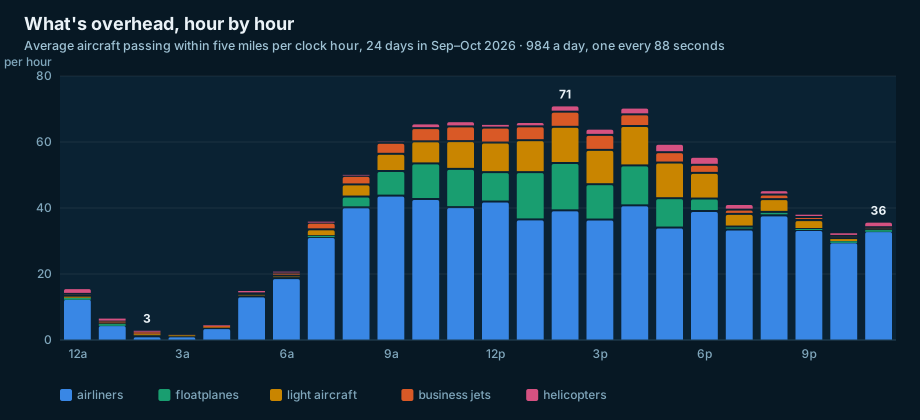
A day over the neighborhood. Airliners are the floor, 30 to 43 an hour from breakfast to midnight. Everything else piles on top of them in the middle of the day, and the floatplanes and flight-school Cessnas go home at dinner.
The shape of a day
Airliners never really stop. The quietest hour is 3 AM, with a couple of passes, and by 5 AM the first bank of arrivals is coming in at thirteen an hour. From 9 AM to 5 PM it holds at around forty an hour, and departures keep it above thirty until midnight. The longest gap with nothing at all in the whole 24 days was three hours, from 2:09 to 5:09 on the morning of October 2.
The small stuff has a working day. Floatplanes start at 8, peak at 2 PM with fourteen an hour, and are done by 7. Light aircraft, mostly flight-school Cessnas from Boeing Field and Renton, follow the same curve. Business jets trickle through all day. Helicopters are the one category that keeps odd hours, because most of them are the medevac flights.
The busiest single hour in the log was 2 PM on Sunday, September 20: 113 aircraft, nearly two a minute. Sundays and Mondays are the busiest days, at about 1,040 passes; Tuesdays and Fridays the quietest, at about 900.
Who it is
Sea-Tac is 58% of everything. Boeing Field is 16%, the Lake Union seaplane base 8%, Paine Field 6%, Renton 3%, Kenmore Air Harbor 2.5%, and the rest is cruise traffic passing over on its way somewhere else.
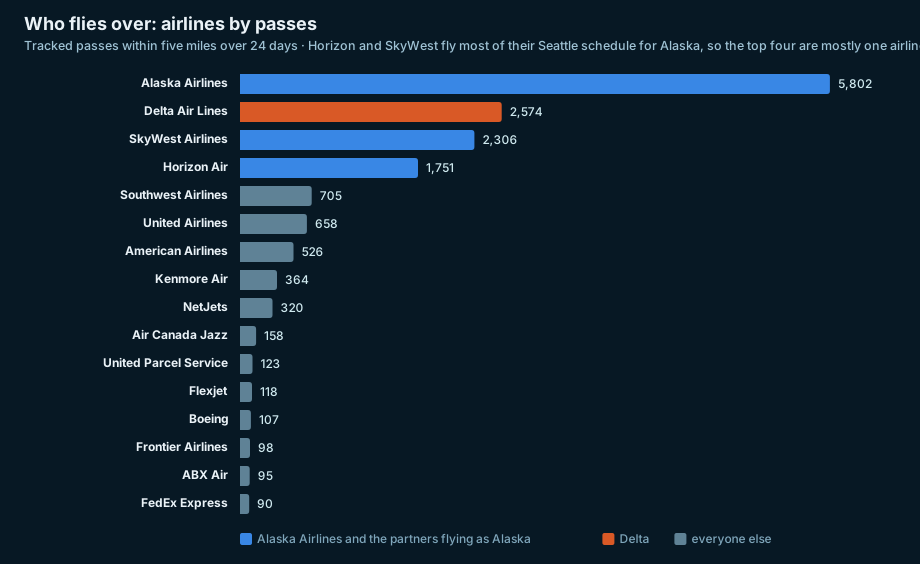
Airlines by passes. SkyWest and Horizon fly the regional jets that wear Alaska's paint, so the top four bars are mostly one airline.
The airline story is Alaska. Count Alaska, Horizon and SkyWest together and they are 60% of all airliner passes over the neighborhood. Delta, which has been building Seattle into a hub for a decade, is 16%. Southwest, United and American together barely beat Horizon alone. After that it drops off fast: Kenmore Air, NetJets, Air Canada's regional arm, UPS, Flexjet, and then Boeing itself, whose factory flights out of Renton and Boeing Field show up as an airline with 107 passes.
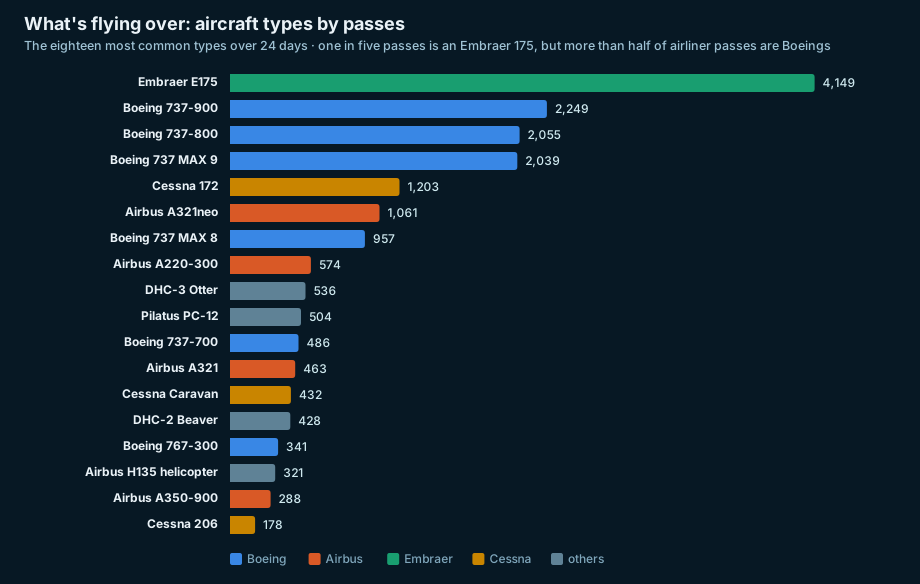
Aircraft types by passes, colored by who built them. The single most common airplane over Seattle is Brazilian.
The most common aircraft over Seattle is the Embraer 175, the 76-seat regional jet, at one pass in five. That surprised me, but it makes sense: it is what Horizon and SkyWest fly to Spokane, Boise, Medford, Redmond and the rest of the Northwest, and those are a lot of flights. The 737 family is still the backbone. Add up the 737-900, 737-800, MAX 9, MAX 8 and 737-700 and Boeing narrowbodies are 7,800 passes, and more than half of all airliner passes are Boeings. Airbus is 18%, almost all of it Delta's A321neos and A220s and American's A321s.
Fifth on the list, ahead of the A321neo, is the Cessna 172.
Where they are going
About one pass in five carries a route, because the station looks the flight number up in a callsign database and only keeps the answer when it agrees with what the plane is doing. That is enough to see the pattern.
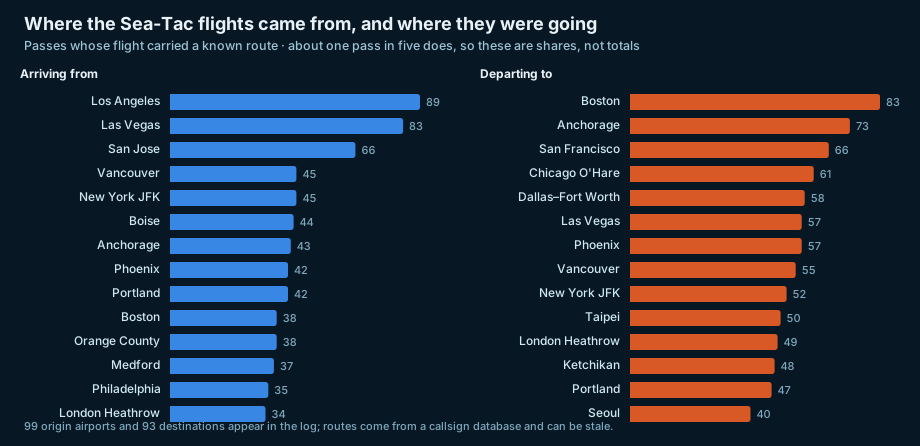
Where the Sea-Tac flights were coming from and going to. Ninety-nine origin airports and 93 destinations appear in 24 days.
The arrivals are California and Las Vegas. The departures are a longer list: Boston, Anchorage, San Francisco, Chicago, Dallas. Some of the asymmetry is which flights happen to get routed over the neighborhood, and some of it is the database, which knows more about some flights than others. Ketchikan is in the top fifteen both ways, which is a very Seattle thing for an airport of 8,000 people to do.
Then there is the long haul.
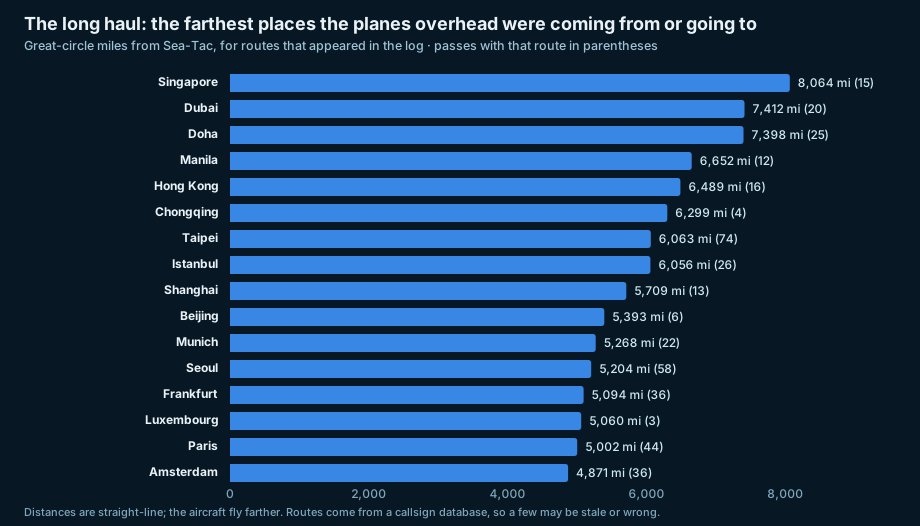
The farthest places the planes overhead had come from or were headed to, by straight-line distance from Sea-Tac.
Singapore is 8,064 miles away and its A350 went over fifteen times. Doha and Dubai are both over 7,000. Taipei is the busiest of the far ones at 74 passes, which is three airlines' worth of flights a day. All told, about thirty foreign carriers went over the house in 24 days: Lufthansa, British Airways, Korean, EVA, JAL, Aer Lingus, China Airlines, Qatar, Turkish, Virgin Atlantic, ANA, Emirates, Air France, Singapore, Cathay, Condor, Asiana, SAS, Philippine, STARLUX, Hainan, Finnair, and the freight operators Cargolux and AeroLogic.
The big ones
Widebodies are 58 passes a day, and they keep a different schedule from the narrowbodies.
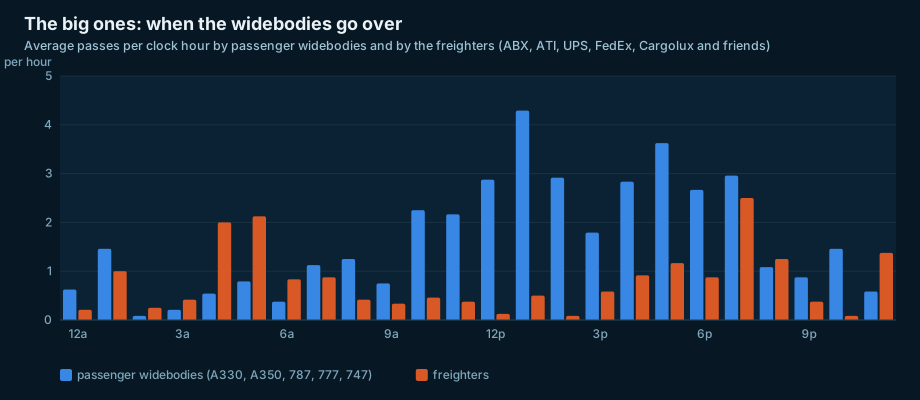
When the widebodies go over. Passengers in the afternoon, freight at dawn and dusk.
The passenger widebodies come in two waves, one around 1 PM when the Asia flights depart, and one from 5 to 7 PM when Europe and the evening Asia bank leave. The freighters do the opposite: 4 to 5 AM, 5 to 7 PM, and a last push at 11 PM, with almost nothing in the middle of the day. The most common widebody of all is not a passenger plane. It is the Boeing 767-300, 341 passes, almost all of them freighters: UPS, FedEx, and ABX Air and Air Transport International, the two that fly for Amazon Air. FedEx still sends MD-11s through, fourteen passes on six flight numbers, which is a treat if you like three-engine airplanes.
Then the ones you see a handful of times and look up. Seven passes by C-17s, the Air Force's big gray transport, on their way into Boeing Field and Sea-Tac. A Boeing 777-9, the stretched one that has been in flight test for years, landing at Boeing Field on October 12. Two P-8 Poseidons, the Navy's 737, flying under Boeing's own callsign. The KC-46 tankers, which show up in the log as 767-200s with Boeing callsigns because that is what they are until the Air Force takes delivery. A Snohomish County Sheriff's Huey. A SeaRey, which is a two-seat amphibious kit plane that looks like a bathtub with wings, twice.
Floatplanes, and the weather
Kenmore Air alone is about 1,600 passes, 7% of everything, in Otters, Beavers and Caravans. Add Seattle Seaplanes and the rest and floatplanes are more than a tenth of all traffic over the neighborhood.
They are also the best weather station in the log.
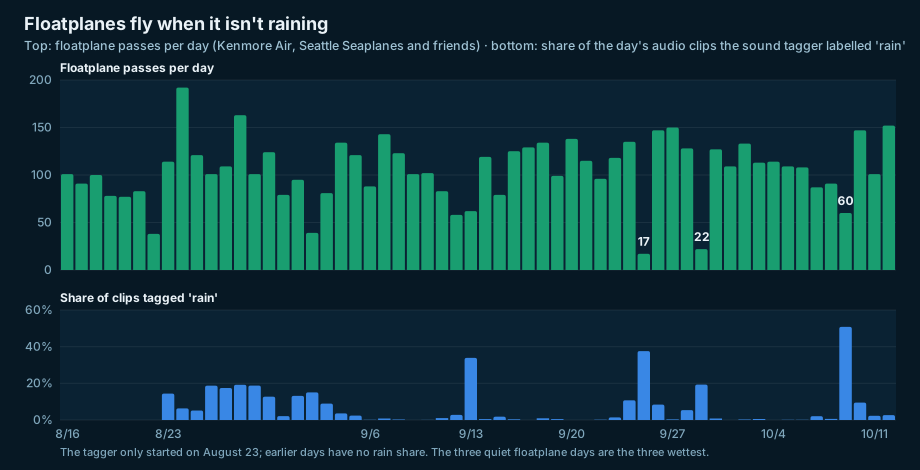
Floatplane passes per day, against the share of each day's audio clips that the sound tagger labelled rain. The three days the floatplanes stayed home are the three wettest days in the log.
Floatplanes fly visual, low, and under the clouds, so on a wet day they mostly don't. The station records that two ways without meaning to: the ADS-B log counts the planes, and the sound tagger, which was there to tell jets from lawnmowers, counts the rain. September 25, September 29 and October 9 are the three days with the fewest floatplanes and the three days with the most rain on the microphone, and nobody told either half of the system about the other. (October 9 is also the day with the suspicious loud readings in the last post. It was raining on the microphone. Mystery mostly solved.)
What has not happened yet is the seasonal fade. I expected the floatplane count to fall off through October, and it hasn't: the dry days in the second week of October look like the dry days in August. Kenmore flies to the San Juans and Victoria year-round. The fade may still come with the weather.
Regulars
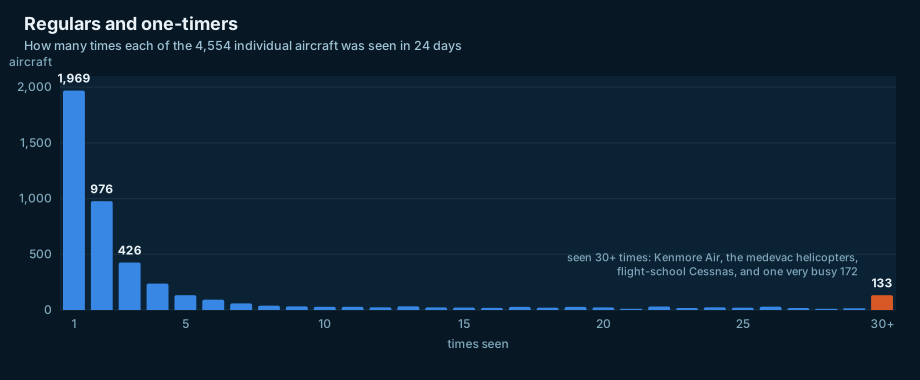
How many times each individual aircraft went over in 24 days. Most came once. A few come all the time.
The 23,623 passes were made by 4,554 individual aircraft, of 247 types, flying under 3,614 different callsigns. Almost half of them, 1,969, went over exactly once. Those are the transcontinental and international planes that rotate through Seattle on a schedule, the business jets, and the cruise traffic.
At the other end, 133 aircraft went over thirty or more times. The regulars are Kenmore's fleet, the two medevac operators (Airlift Northwest's EC135s and Life Flight's Bell 429s, 434 passes between them), the Emerald City tour helicopter, and the flight schools. The most frequent aircraft of all, by a wide margin, is a Cessna 172 on floats belonging to Seattle Seaplanes: 311 passes in 24 days, thirteen a day, which is somebody learning to land on water, over and over, right over the neighborhood. The busiest airline flight number is American's flight 767, an A321, at 32 passes, but the busiest flight of any kind is Kenmore's 1710, a Caravan, at 51.
Fast and slow
The airliners cross the neighborhood at a median of 257 knots, which is 296 mph. Arrivals are slower, with their gear and flaps out; departures are faster and still accelerating. The fastest things in the log are not airliners at all but business jets passing high overhead at cruise: a Falcon 8X at 448 knots, a Global 7500 at 447, a Gulfstream V at 431.
The slowest aircraft in the log was a Cessna 206 on floats doing 5 knots on its way into Lake Union, which is to say it was a boat at the time. Helicopters have a median of 42 knots and a tenth of them are doing less than 2, which is what hovering looks like to a transponder.
A few caveats
The route data is the weak spot. It covers a fifth of passes, comes from a public callsign database that is sometimes stale, and the station throws out any route that does not match what the plane is doing. The ranking of cities is right; the exact counts are not.
Five miles is a choice. Move the radius and every number moves with it. The hour-by-hour shape and the shares would not change much; the totals would.
And 24 days in early fall is one season. The floatplanes alone say this would look different in January.
What I learned
It is a lot of airplanes. I knew the approach went over the neighborhood. I did not know it was a thousand a day, or that the floor never drops below one an hour, or that an eighth of them are floatplanes.
Seattle is an Alaska town, then a Boeing town. Three out of five airliners overhead are Alaska or flying for it. More than half are Boeings. The single most common airplane is an Embraer, which I will now notice every time.
Ground truth leaks. I set out to count planes and ended up with a rain gauge. The floatplanes know the weather, the tagger hears the weather, and the two agree without ever having met. Every dataset is secretly also about something else.
The sky is more varied than it sounds. From the ground it is 737s all day. In the log it is 247 types, from a kit plane shaped like a bathtub to a 777 that is not for sale yet, passing over the same block.
Next time one goes over, there is a decent chance it is an Embraer 175 going to Spokane, and a small but real chance it is a C-17.